
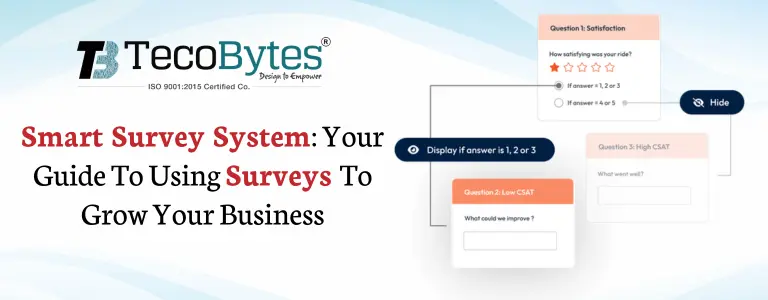
Understanding how customers think about your business matters for the growth of your business. But a lot of people guess instead of asking. A smart survey system makes it easy to ask the right questions and get honest answers. No guessing. Those answers guide better decisions. It skips assumptions. You collect real insights from customers and employees, plus people who might buy. That feedback helps and acts like a roadmap for improvement. In this competitive market knowing the customer’s thoughts and understanding plays a key role in the growth of a business. This guide shows how a smart survey system helps you make smarter decisions and improve your business.

What Is a Smart Survey System?
A smart survey system is not like listing questions and sending them in bulk to your mailing list. It is an integrated, data-driven approach to gather, analyse and act on customer and employee feedback at the right time. Through the right channel and to the right people.
For example, a traditional survey is a fishing net thrown randomly into the ocean. A smart survey system is a sonar-guided spear. Precision matters.
Core components of a smart survey system include the following:
- Targeted distribution
- Conditional logic
- Real-time analytics
- Automation triggers
- Integration with your CRM or marketing tools
Integration with your CRM or marketing tools helps connect survey responses directly with your customer data. This makes it easier to understand customer behavior, track interactions, and identify patterns across different touchpoints. As a result, insights don’t stay isolated — they directly support smarter marketing, sales, and business decisions.
Many people wonder if free tools like Google Forms qualify. They can be a starting point but they lack automation and deep segmentation and analytics that make a system truly smart. Tools like Typeform, SurveyMonkey, Qualtrics or Hotjar for on-site surveys are better suited to business growth.
The Advantages of a Smart Survey System
People often ask: why not just read customer reviews or track sales data? The answer is simple — the customer reviews tells you what happened. The customer Surveys tell you why. And the ‘why’ is where growth lives.
- Faster, Sharper Decision-Making
When survey data feeds directly into your reporting dashboard, your team stops guessing. Because they will get an idea of if customers actually want that new feature you’ve been building? Ask them before you ship. This saves development time, marketing budget, and protects your brand reputation.
- Improved Customer Retention
Sending a short post-interaction survey, even just a 3-question NPS (Net Promoter Score) survey helps to tell the customers that you are caring about their experiences. Businesses that act on this data see measurable improvements in loyalty.
- Competitive Intelligence
A well-crafted survey can reveal how customers recognised your brand compared to your competitors. This information you simply can’t get from analytics alone. This shapes everything from your pricing strategy to your messaging.
- Employee Insight
Smart survey systems aren’t just for customers. Regular pulse surveys within your team surface morale issues before they become turnover problems — and that directly impacts your bottom line.

How to Use Surveys Effectively to Grow Your Business
A common question that comes up. How many questions should a survey have? Short answer. A survey has fewer questions only. Surveys that are longer than 5 minutes see a dramatic drop in completion rates. Aim for 5–8 targeted questions per survey. Your data will be far better than after a 30-question marathon.
- Set a Single and Clear Goal
Before you build the survey. This data helps me to take what decision? Firstly you need to answer this. If you can’t answer that, you’re not ready to survey yet. Every question should trace back to that central goal.
- Audience Segmentation
Don’t send the same survey to a first-time buyer and a long-term loyal customer. Segment by purchase history and location or group people by behaviour. Targeted surveys generate 30–40% higher response rates and give more actionable insights.
- Time It Right
Trigger surveys at moments that matter. Right after a purchase. Seven days after product delivery. Or right after a support interaction closes. The closer to the experience, the more accurate the recall. Automation tools let you set these triggers once and let them run.
- Close the Loop
This is where most businesses fail. Collecting customer feedback without acting on it actually damages trust. When customers see a change made because of their input, it creates loyalty to the business. Even a simple follow-up email saying “You told us X, so we did Y” is powerful. Publish a monthly summary internally so your team knows what customers are saying and what has changed because of it.
Checklist and Precautions Before You Hit Send
Before launching your next survey, run through this checklist. Skipping even one of these steps can quietly kill your response rate or worse — skew your data and lead you to the wrong conclusions.
Pre-Launch Checklist:
- Goal is clearly defined — one survey, one core question it answers.
- Questions are neutral — avoid leading language like ‘How much did you love our service?’
- Survey is mobile-friendly — over 60% of surveys are opened on phones.
- Estimated completion time is shown — ‘2 minutes’ boosts response rates.
- You’ve piloted with a small group (5–10 people) before the full send.
- Incentives are offered if needed — a small discount code can double response rates.
- Privacy and data handling needs to be clearly communicated — especially important in GDPR regions.
- You have to set a plan to analyze results within 48 hours of the survey closing.
- Your follow-up action is mapped out before the data even arrives.
- Survey results will be shared with the relevant internal team.
Critical Precautions:
- Never survey too frequently – Surveying the same audience more than once a quarter leads to fatigue and unsubscribes.
- Avoid survey stacking – Better to not ask the customers to complete multiple surveys in a short window.
- Don’t ignore open-ended responses – They often hold unexpected insights.
- Be cautious with incentivised surveys – Rewards can attract responses from people who don’t represent your real customer base.
- Always double-check skip logic before sending — Broken paths make incomplete data.
Conclusion
A smart survey system isn’t a luxury reserved for enterprise-level companies with big research budgets. Today, any business with the will to listen can build one. The tools are accessible, the methodology is learnable, and the returns in retention, revenue, and product direction are very real. The businesses that grow consistently in competitive markets share one trait: they ask better questions than everyone else. They don’t assume, they verify. They don’t react, they anticipate. And they use surveys not just to measure satisfaction, but to actively shape their next move. Start with one goal. Build one survey. Act on the data. Then repeat and watch the compounding effect it has on your growth trajectory.