

A website may have amazing content, strong backlinks and well-researched keywords, but it still struggles with its search rankings, especially in highly competitive areas. The reason is simple. Modern search engines no longer just work on SEO metrics, the new core Web Vitals and user experience are also among the new ranking factors on search . Businesses that ignore website speed, ease of use, visual stability and user interaction on the website, the ranking is likely to drop compared to the competition.
While a couple of years ago the focus on SEO was primarily about backlinks, keyword density and technical elements of a website, nowadays it all comes to how users behave on the website after they click the result in the search. Google and AI-driven search systems increasingly analyze engagement signals, page responsiveness, mobile usability, loading performance, and behavioral patterns before deciding which websites deserve stronger visibility.
Nowadays the users demand that websites are instantaneous and very smoothly designed, mobile friendly and easy to navigate regardless if they use desktop, mobile phone or tablet. The majority of users do not wait anymore on loading webpages, they do not have time to wait on a broken design or poorly responsive interface. So this huge change in behavior of internet users is the exact reason why Core Web Vitals optimization is one of the most essential search priorities in 2026.
If a business works on the website’s speed and user experience, it will see the results like improvement in rankings, low bounce rates and increasing customer loyalty. Poor website usability still results in poor search rankings even if traditional SEO of the website is great.

What Are Core Web Vitals?
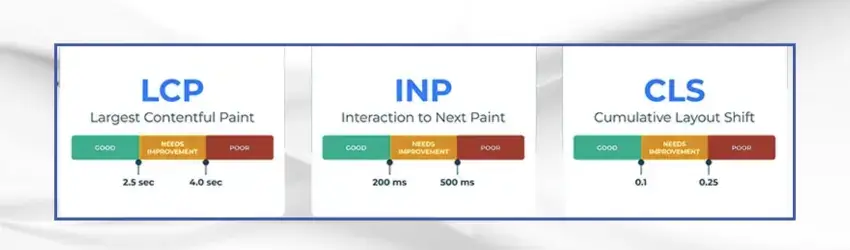
Core Web Vitals are performance metrics introduced by Google to measure real-world user experience on websites. These metrics evaluate how quickly pages load, how responsive they are, and how stable layouts remain while users interact with content. Core Web Vitals mainly focus on:
- Loading performance
- Interactivity
- Visual stability
The three primary Core Web Vitals metrics include:
Largest Contentful Paint (LCP)
- LCP measures how quickly the main content of a webpage becomes visible to users.
- A good LCP score generally means content loads within 2.5 seconds.
Interaction to Next Paint (INP)
- INP measures responsiveness and how quickly websites react when users interact with buttons, forms, or menus.
- Slow interactions create frustration and reduce usability.
Cumulative Layout Shift (CLS)
- CLS measures visual stability.
- Unexpected layout shifts, moving buttons, or jumping text create poor user experiences and negatively affect usability.
These metrics help search engines evaluate whether websites provide smooth browsing experiences.
Why User Experience Matters More in 2026
User behavior has changed significantly.
Modern users expect:
- Faster loading speeds
- Mobile-friendly layouts
- Instant interactions
- Clear navigation
- Stable page designs
People rarely wait for slow websites anymore.
If a website loads slowly or behaves poorly, users often leave immediately and visit competitor websites instead. Search engines interpret this poor engagement as a sign of lower content quality. This is why user experience optimization now directly affects SEO performance.
Website Speed & Performance
Website speed remains one of the strongest UX optimization signals.
Slow websites negatively affect:
- Bounce rates
- User engagement
- Conversion rates
- Search visibility
Now people will give up a website in case it takes more than a few seconds to load.
Businesses should optimize:
- Image sizes
- Hosting infrastructure
- CSS and JavaScript files
- Browser caching
- Server response times
Fast websites create better experiences while improving SEO performance naturally. Large images are also one of the biggest reasons websites load slowly. Businesses should optimize:
- File compression
- Modern image formats
- Lazy loading
- Proper image dimensions
Optimized images improve loading speeds without reducing visual quality. Reliable hosting infrastructure also plays a major role in Core Web Vitals optimization. Weak hosting environments often create:
- Downtime
- Slow response times
- Delayed interactions
- Poor page stability
Businesses investing in quality hosting usually achieve stronger UX optimization and SEO performance.
Mobile UX Optimization
Mobile devices now dominate internet traffic globally.
Search engines heavily prioritize mobile-first indexing, meaning websites are primarily evaluated through their mobile versions.
Businesses should ensure:
- Responsive layouts
- Fast mobile speeds
- Readable text
- Touch-friendly navigation
- Optimized images
Poor mobile usability damages both rankings and conversions.
Core Web Vitals performance becomes even more important on smartphones because mobile users expect instant browsing experiences.
Strong mobile UX optimization supports both Core Web Vitals performance and SEO visibility.
Businesses should also improve:
- Mobile interaction quality
- Content formatting
- Page responsiveness
- Mobile navigation structure
Websites that perform poorly on mobile devices often experience lower engagement and weaker rankings.
Core Web Vitals & UX Optimization: SEO Factors That Matter in 2026
Websites with strong Core Web Vitals and UX optimization often benefit from:
- Better rankings
- Lower bounce rates
- Higher engagement
- Improved customer trust
- Better conversion rates
Modern search engines now evaluate how users interact with websites after clicking search results. Businesses improving Core Web Vitals are creating faster, smoother, and more user-friendly experiences that directly support SEO growth in 2026. Now let’s explore how each of these factors affects rankings and user experience.
1. Better Rankings
One of the biggest advantages of strong Core Web Vitals optimization is improved search visibility.
Search engines increasingly prioritize websites that provide:
- Fast loading speeds
- Smooth page interactions
- Stable layouts
- Mobile-friendly experiences
- Better usability
When websites perform well technically and offer strong UX optimization, search engines often reward them with stronger rankings.
Businesses improving Core Web Vitals may achieve:
- Better keyword rankings
- Higher organic traffic
- Improved search visibility
- More indexed pages
- Stronger long-term SEO stability
Fast and user-friendly websites now have a clear advantage in competitive search results.
2. Lower Bounce Rates
Users rarely wait for slow or frustrating websites.
If a webpage loads slowly or becomes difficult to navigate, visitors often leave immediately. Search engines interpret this behavior negatively because it suggests weak user experience.
Strong Core Web Vitals optimization helps reduce bounce rates by improving:
- Loading speed
- Mobile responsiveness
- Navigation clarity
- Page stability
- User interactions
For example:
- Faster websites keep users engaged longer
- Stable layouts reduce frustration
- Responsive pages improve browsing experiences
Lower bounce rates often contribute to stronger SEO performance over time.
3. Higher Engagement
Engagement signals are becoming increasingly important in SEO.
Search engines now analyze how users interact with websites after arriving from search results.
Websites with strong UX optimization often generate:
- Longer session duration
- More page views
- Better interaction rates
- Improved scroll behavior
- Higher user retention
Businesses improving Core Web Vitals create smoother experiences that encourage visitors to explore more content naturally.
For example:
- Fast-loading blogs increase reading time
- Responsive pages improve interaction quality
- Clear navigation encourages deeper browsing
Higher engagement sends positive behavioral signals to search engines.
4. Improved Customer Trust
Trust has become a major ranking and conversion factor in modern SEO.
Users often judge businesses based on website quality and browsing experience.
Poor UX optimization can create problems such as:
- Broken layouts
- Slow loading pages
- Delayed interactions
- Mobile usability issues
- Confusing navigation
These issues reduce trust quickly.
Strong Core Web Vitals optimization improves customer confidence because websites appear:
- Faster
- More professional
- More reliable
- Easier to use
- Better organized
Businesses providing smooth experiences often build stronger brand credibility online.
5. Better Conversion Rates
Good user experience directly affects conversions.
Visitors are more likely to:
- Contact businesses
- Submit forms
- Purchase services
- Read additional content
- Return later
when websites perform smoothly.
Poor UX optimization often causes users to abandon websites before completing actions.
Businesses improving Core Web Vitals may increase:
- Lead generation
- Sales conversions
- Customer engagement
- Retention rates
- Revenue growth
For example:
- Faster checkout pages reduce abandonment
- Mobile-friendly forms improve submissions
- Stable layouts improve usability
Better experiences usually create stronger business results.
Visual Stability & Navigation
Unexpected layout movement damages usability.
Common issues include:
- Buttons shifting suddenly
- Images loading late
- Text jumping while reading
- Popups blocking content
Stable layouts improve:
- Readability
- Navigation
- Trust
- User satisfaction
- Engagement
Visual stability is becoming increasingly important for both UX optimization and Core Web Vitals performance.
Clear navigation also helps users find information quickly.
Businesses should improve:
- Menu organization
- Internal linking
- Search functionality
- Category structures
- Content hierarchy
Well-structured websites improve usability while helping search engines understand content relationships more effectively.
Strong internal linking also improves:
- User engagement
- Session duration
- Crawling efficiency
- Content discovery
Well-connected websites often perform better in search visibility.

AI Search and Behavioral Signals
AI-powered search engines now analyze behavioral signals more deeply.
Modern search systems evaluate:
- Interaction quality
- Engagement duration
- User satisfaction
- Navigation behavior
- Browsing patterns
Businesses improving Core Web Vitals are positioning themselves better for AI-driven SEO environments where user experience strongly influences rankings.
Modern search behavior is becoming increasingly:
- Conversational
- Mobile focused
- AI driven
- Experience centered
Businesses relying only on outdated UX and SEO tactics may struggle as search systems continue evolving.
Final Thoughts
The growing importance of Core Web Vitals and UX optimization reflects the major transformation happening in SEO during 2026. Search engines now prioritize websites that provide fast, stable, and user-friendly experiences instead of focusing only on traditional ranking factors.
Businesses improving Core Web Vitals often achieve better rankings, lower bounce rates, higher engagement, stronger trust, and improved conversion rates. As AI-powered search continues evolving, user experience signals will likely become even more important for long-term SEO visibility.
Ultimately, websites combining strong content with excellent UX optimization are positioning themselves for stronger growth, better engagement, and long-term search success in 2026 and beyond.