
Introduction
One of the key things to know while building a website is the behaviour of website users. Businesses may remodel their entire website based on guess work, personal likes or trends without focusing on their users behaviour in their websites. This often leads to disappointing results. Heatmaps and session recordings will provide the knowledge required for redesigning of a website, they will help you to notice users’ frustrations and help you to improve site navigation, to boost engagement and to design your website that will meet customers’ needs as well as your business’ needs.
In 2026, user experience is going to play a key role in SEO. This also helps to increase conversions and customer retention. Users expect your website to be loaded quick enough, easily navigable and free from any obstacles in the way of finding information.
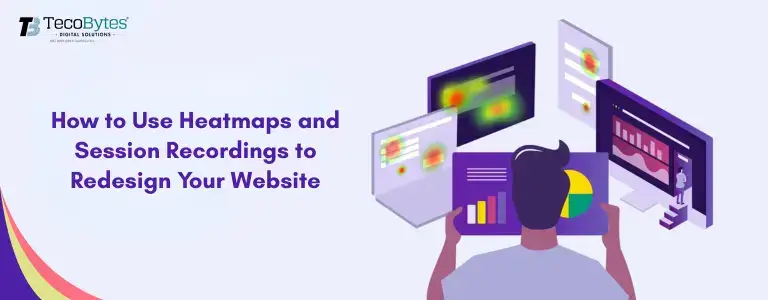
What Are Heatmaps?
Typically:
- Red indicates high engagement.
- Yellow indicates moderate engagement.
- Blue indicates low engagement.
One of the biggest advantages of heatmaps and session recordings is that they simplify user behavior analysis. Instead of relying solely on numbers and reports, businesses can visually identify how users interact with different website elements.
Types of Heatmaps
Click Heatmaps
Click heatmaps show where visitors click most frequently.
They help businesses understand:
- Which buttons attract attention
- Which links generate interaction
- Which areas confuse visitors
- Which elements users expect to be clickable
Scroll Heatmaps
Scroll heatmaps reveal how far users move down a page.
This information helps determine:
- Whether visitors reach important content
- Which sections receive attention
- Where users lose interest
Move Heatmaps
Move heatmaps track cursor movements and provide clues about visitor attention and browsing behavior. Using different types of heatmaps and session recordings together creates a clearer understanding of user interactions.
What Are Session Recordings?
Session recordings let the businesses to observe individual user visits by replaying the journey and making it possible to understand how visitors interact with a website in real time.
These recordings capture:
- Mouse movements
- Scrolling behavior
- Click activity
- Navigation patterns
- Form interactions
Businesses often use heatmaps and session recordings together because each tool answers different questions. Heatmaps show what users are doing collectively, while session recordings explain why they are behaving that way.

Why Heatmaps and Session Recordings Matter
Most website analytics tools provide valuable metrics such as:
- Page views
- Bounce rates
- Traffic sources
- Conversion rates
However, these metrics rarely explain user behavior.
For example:
A page may have a high bounce rate, but analytics alone cannot explain why visitors are leaving.
This is where heatmaps and session recordings become valuable.
They help businesses discover:
- Navigation problems
- Poor content placement
- Frustrating user experiences
- Hidden conversion barriers
- Mobile usability issues
These insights make redesign decisions more accurate and effective.
How to Use Heatmaps and Session Recordings to Redesign Your Website
This is where heatmaps and session recordings become especially powerful. Instead of redesigning based on assumptions, businesses can make decisions using actual visitor behavior.
Analyze Your Most Important Pages
Start by reviewing pages that contribute most to business objectives.
Examples include:
- Homepage
- Service pages
- Product pages
- Landing pages
- Contact pages
Improving high-traffic pages often creates the greatest impact.
Identify User Drop-Off Points
Scroll heatmaps help identify where visitors stop engaging with content.
Look for:
- Sections where engagement decreases
- Areas visitors skip
- Content placed too low on the page
Moving important information higher can improve engagement.
Study Click Behavior
Click heatmaps reveal what attracts visitor attention.
Analyze:
- Frequently clicked elements
- Ignored buttons
- Navigation patterns
- Unexpected user behavior
This information helps improve usability and page structure.
Watch Session Recordings
Session recordings reveal specific user frustrations.
Common indicators include:
- Repeated clicking
- Rapid scrolling
- Hesitation before actions
- Back-and-forth navigation
These behaviors often indicate confusion or friction.
Improve Calls-to-Action
Many businesses discover through heatmaps and session recordings that visitors overlook important calls-to-action.
Evaluate:
- Button placement
- Visibility
- Messaging
- Page positioning
Small changes can significantly improve conversions.
Understanding Scroll Behavior
Scroll behavior provides important insights into content performance.
Many businesses assume visitors read entire pages. In reality, users often leave before reaching critical information.
Scroll heatmaps help answer questions such as:
- How far do users scroll?
- Which sections receive attention?
- Where do visitors lose interest?
If most users leave before reaching key content, redesigning the page structure may improve performance.
Using heatmaps and session recordings to analyze scroll patterns helps businesses place important information where users are most likely to see it.
Optimizing Landing Pages
Landing pages often play a critical role in lead generation and sales.
Heatmaps and session recordings help identify landing page weaknesses.
Headline Effectiveness
Visitors decide quickly whether a page is relevant or not. So, analyze whether users continue engaging after reading the headline.
Call-to-Action Visibility
Heatmaps reveal the information about whether the visitors notice the important buttons or not.
Content Structure
Long blocks of text often reduce engagement. Session recordings frequently reveal the information about whether the visitors are skipping large sections of content.
Trust Signals
Visitors often seek:
- Reviews
- Testimonials
- Certifications
- Success stories
Heatmaps can reveal whether users engage with these elements.
Businesses that use heatmaps and session recordings effectively can create landing pages that better support conversions.
Improving Mobile User Experience
Mobile traffic now accounts for a significant percentage of website visits.
A website that performs well on desktop may still create challenges for mobile users.
Common mobile problems include:
- Small buttons
- Difficult navigation
- Slow loading speeds
- Excessive scrolling
- Hidden content
By reviewing mobile-specific heatmaps and session recordings, businesses can identify mobile usability issues and improve the overall experience.
Since Google uses mobile-first indexing, mobile optimization also supports SEO performance.
Detecting Form Abandonment Issues
Forms are essential for:
- Lead generation
- Contact requests
- Registrations
- Purchases
However, many businesses struggle with form abandonment.
Session recordings often reveal why users fail to complete forms.
Common causes include:
- Too many fields
- Confusing instructions
- Validation errors
- Poor mobile design
- Privacy concerns
Watching session recordings helps identify the exact points where users abandon the process.
Improving forms based on these findings often increases conversions.
Understanding Content Engagement
Content plays a major role in attracting and retaining visitors.
Not all content performs equally.
Using heatmaps and session recordings, businesses can identify:
- Which sections attract attention
- Which content is ignored
- Which elements encourage interaction
- Which topics generate engagement
For example, if users consistently skip a particular section, it may require restructuring or rewriting.
Content engagement analysis helps improve:
- Readability
- Information hierarchy
- Content placement
- User experience

Combining Heatmaps with Analytics
Although heatmaps and session recordings provide valuable insights, they work best when combined with traditional analytics.
Analytics tools answer questions such as:
- How many visitors arrive?
- Which pages perform best?
- What are conversion rates?
Heatmaps and session recordings explain:
- Why visitors leave
- Why users ignore calls-to-action
- Why conversions remain low
For example:
- Analytics may reveal a high bounce rate.
- Heatmaps may reveal poor content placement.
- Session recordings may reveal user confusion.
- Together, these insights support more effective redesign decisions.
Best Practices for Using Heatmaps and Session Recordings
To maximize results:
Collect Sufficient Data
Avoid making decisions based on a small number of visits.
Analyze Multiple Devices
Desktop and mobile users behave differently.
Focus on Business Objectives
Review behavior in relation to:
- Leads
- Sales
- Engagement
- Signups
Review Data Regularly
User behavior changes over time.
Test Improvements
After making changes, continue using heatmaps and session recordings to measure results. Continuous optimization leads to better long-term performance.
Final Thoughts
Redesigns of websites are only successful when they are not designed based on assumptions but are grounded on the real behaviors of the actual users of the website. Heat maps and session recordings provide the necessary information to businesses as it can assist to solve issues related to usability, navigation, content placement and other conversion boosting strategies of the websites.
Utilizing session recordings and heatmaps can help organizations to develop a stronger understanding of how users navigate through the website, expose problem areas and optimize the experiences that can ultimately fulfill the goals of visitors. Organizations that want to lower bounce rates, increase the number of leads generation, increase sales or to improve customer satisfaction; these data and tools can make much informed design decisions.
With more businesses operating on the digital medium with ever-increasing competition, companies that continually invest time in understanding how visitors are using the website and subsequently upgrade the websites based on the observed information would always be rewarded with sustainable growth and increased engagement in the long term.