Introduction
As a business begins to grow its presence online is one of the biggest decisions that comes into play . Whether a company opts for an SaaS, or Self-hosted, deployment model. Most of the businesses often debate SaaS vs Self-Hosted Solutions not only on the monthly or yearly charges, but rather on the long-term operational benefits and cost of ownership. And few organizations are often looking at just the hosted fees and the monthly payments, which is only part of the picture.
When a business is beginning to scale there is where the reality of SaaS vs Self-Hosted Solutions really comes in. This is where the costs of scalability, maintenance and staffing add up, and in a lot of cases it may seem more cost effective in the early days but not necessarily when it comes down to the overall operational requirements. Software-hosted platforms make it that much easier to be able to manage infrastructure updates, security and development, but they also come with fixed costs whereas you do not necessarily get the full benefit for a Self-hosted platform.
This guide helps you to understand SaaS vs Self-Hosted Solutions and helps to make the right choices without any costly surprises.

What is SaaS?
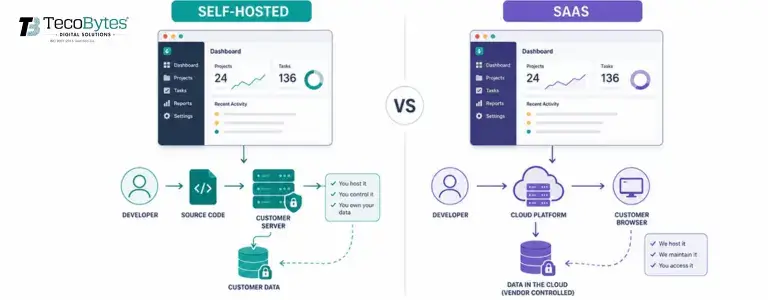
In SaaS platforms:
- Infrastructure is managed by the provider
- Updates happen automatically
- Security is handled centrally
- Scaling is usually instant
SaaS removes most technical responsibilities from the business. Popular examples include CRM tools, project management systems, and website hosting platforms that run entirely in the cloud.
What is a Self-Hosted Solution?
A self-hosted solution is software that a business installs and manages on its own server or cloud infrastructure. Unlike SaaS, the organization has full control over configuration, updates, and performance.
In self-hosted systems:
- The company manages servers
- Updates must be applied manually
- Security is handled internally
- Customization is fully flexible
In SaaS vs Self-Hosted Solutions the self-hosted systems offer control but require technical expertise and ongoing maintenance.

SaaS vs Self-Hosted Solutions: Total Cost of Ownership for Growing Businesses Website Overview
The key difference in SaaS vs Self-Hosted Solutions is how the cost is distributed over time.SaaS spreads costs into predictable monthly or yearly subscriptions, while self-hosted solutions concentrate costs into infrastructure, staffing, and maintenance responsibilities.A proper analysis of SaaS vs Self-Hosted Solutions includes both visible and hidden expenses, not just licensing fees or hosting bills.
Initial Setup Costs
Initial investment is the first major difference in SaaS vs Self-Hosted Solutions
SaaS requires:
- Subscription activation
- Minimal setup time
- No infrastructure purchase
Self-hosted systems require:
- Server or cloud setup
- Software installation
- Configuration and deployment
- Developer involvement
This makes SaaS significantly cheaper at the beginning. In SaaS vs Self-Hosted Solutions self-hosted systems always demand higher upfront technical effort and cost.
The amount of time needed to get the system ready for business use is another factor that influences the initial investment . Basically SaaS platforms gives quick deployment, allowing teams to start working almost immediately after subscribing. This can help businesses to reduce the delays and focus on growth instead of spending time on technical setup.
Infrastructure and Hosting Costs
Infrastructure plays a continuous role in SaaS vs Self-Hosted Solutions
With SaaS:
- Hosting is included
- Scaling is automatic
- No server management is required
With self-hosted systems:
- Cloud servers must be purchased separately
- Bandwidth usage increases cost
- Storage expansion is ongoing
- Backup systems must be configured
As a business grows, infrastructure requirements may change.The traffic to the site will increase and more users on the system and need to store more data. SaaS solutions usually handle these growth demands seamlessly, while with self-hosted applications you have to keep an eye on how much resource is being consumed and expand infrastructure accordingly. This will constantly add costs over time.
Maintenance and Technical Workload
Maintenance is one of the biggest hidden cost drivers in SaaS vs Self-Hosted Solutions.
SaaS providers handle:
- Bug fixes
- Updates
- Performance improvements
- Security patches
Self-hosted systems require:
- Internal IT team or freelancers
- Regular updates
- Debugging issues
- Version upgrades
This ongoing effort increases operational cost significantly
Maintenance goes beyond just applying updates to the system. It involves checking back ups, keeping an eye on the system’s performance, fixing technical issues and verifying that all systems are working as they should. Although these can all appear to be relatively small tasks , as a whole, they could consume a lot of time and effort. Companies relying on a self-hosted system need to devote time and resources to tasks such as these. Typically, these tasks would already be included in a SaaS system.
Scaling and Growth Costs
Scalability is crucial in SaaS vs Self-Hosted Solutions.
SaaS platforms allow:
- Instant upgrades
- Flexible pricing tiers
- Automatic resource scaling
Self-hosted systems require:
- Manual server upgrades
- Load balancing setup
- Performance testing
- Additional infrastructure planning
As traffic grows, SaaS vs Self-Hosted Solutions shows SaaS is more predictable while self-hosted systems become operationally heavy.The growth of a business can also cause sudden shifts in demand. High traffic to a website or a rapid surge in user growth can create demand for more resources to support the increased performance required. A SaaS product is typically designed to scale easily to manage such a spike, but in a self-hosted system a business might have to invest in more servers, storage or network bandwidth which will have financial implications and can also be disruptive.
Security and Compliance Costs
Security is a major cost factor in SaaS vs Self-Hosted Solutions.
SaaS providers invest in:
- Enterprise-grade encryption
- Firewalls and monitoring
- DDoS protection
- Compliance certifications
Self-hosted systems require:
- Security engineers
- Monitoring tools
- Regular audits
- Incident response systems
Security needs are constantly changing as threats get more complex. Companies need to safeguard not only customer data, but industry-specific regulations as well as privacy guidelines. In most cases, SaaS includes security monitoring, compliance features and patches at no extra cost, self-hosted servers can’t offer the same level of protection without considerable tool/expertise/investment.
Downtime and Business Risk
Downtime is often ignored in SaaS vs Self-Hosted Solutions but it has real financial impact.
SaaS platforms typically offer:
- High uptime guarantees
- Redundant infrastructure
- Disaster recovery systems
Self-hosted solutions depend on:
- Server stability
- Internal monitoring
- Manual recovery processes
A small loss of down-time is still enough to affect revenue. Downtime costs businesses more than just service interruptions. Loss of sales, loss of customer trust, and lowered productivity are a few examples of long-term consequences of service downtime. Most SaaS solutions include multiple tiers of redundancy, lowering the probability of downtime, whereas businesses with self-hosted solutions will often have to create and administer their own disaster recovery strategies.
Staffing and Operational Costs
Human resources are one of the largest expenses in SaaS vs Self-Hosted Solutions
SaaS reduces the need for:
- System administrators
- DevOps engineers
- Security teams
Self-hosted systems require:
- Dedicated IT staff
- Infrastructure engineers
- Support personnel
Over several years, staffing has become a major factor in SaaS vs Self-Hosted Solutions, often exceeding infrastructure costs. Technology platforms need continued skilled work. As systems grow complex, additional employee resources might be needed to manage infrastructure, support and security. However, finding staff, training and retaining them is another total cost. Businesses sometimes forget to factor this into a total cost of ownership.
Customization and Development Costs
Customization is another key difference in SaaS vs Self-Hosted Solutions.
SaaS platforms:
- Offer limited customization
- Reduce development cost
- Provide standardized features
Self-hosted systems:
- Offer full flexibility
- Require continuous development
- Increase long-term maintenance cost
Despite the freedom with self-hosted solutions, it rarely comes as a one off payment. Customization requires maintenance and upgrades throughout your business life cycle. Custom functionalities require constant support to upgrade and test as the business requirements evolve. Customization costs escalate with time and add additional dependencies. Although SaaS may limit the flexibility to customize the product, it also significantly reduces the development costs and adds very few additional dependencies.
Upgrade and Innovation Costs
Technology upgrades play an ongoing role in SaaS vs Self-Hosted Solutions.
SaaS:
- Automatic updates
- No downtime during upgrades
- Continuous feature delivery
Self-hosted:
- Manual upgrades
- Testing requirements
- Possible compatibility issues
Technology evolves rapidly, and businesses must adapt to remain competitive. SaaS providers continuously release new features, performance improvements, and security enhancements without requiring significant effort from customers. In self-hosted environments, upgrades often require planning, testing, and deployment activities that consume both time and resources. These factors should be considered when calculating long-term ownership costs.
Long-Term Cost Comparison
Over 3–5 years, long term cost comparison in SaaS vs Self-Hosted Solutions becomes clearer.
SaaS provides:
- Predictable expenses
- Lower operational complexity
- Faster deployment
Self-hosted provides:
- Potential long-term savings at scale
- Full ownership
- Greater control
However, for most startups and mid-sized companies, SaaS favors due to lower hidden costs. A meaningful cost comparison should include both direct and indirect expenses. Subscription fees and hosting costs are only part of the equation. Staffing requirements, maintenance responsibilities, security investments, and potential downtime can significantly affect overall spending. Looking at the complete picture allows businesses to make better-informed decisions and avoid unexpected costs as they continue to grow.
Risk Factors in Total Cost
Risk is an important but often ignored part of SaaS vs Self-Hosted Solutions.
SaaS risks:
- Vendor lock-in
- Pricing changes
Self-hosted risks:
- Security breaches
- System failures
- Higher operational burden
Factoring risk into SaaS vs Self-Hosted Solutions provides a more realistic financial picture.
Which One is Better for Growing Businesses?
For most growing companies, SaaS vs Self-Hosted Solutions analysis shows SaaS is more practical.
It reduces:
- Technical burden
- Maintenance costs
- Setup complexity
Self-hosted solutions are better when:
- Deep customization is required
- Strong technical teams exist
- Full data control is needed
Conclusion
From this full analysis of the SaaS vs Self-Hosted Solutions: Total Cost of Ownership for Growing Businesses Website, it is clear that the real costs are much higher than just subscription fees or hosting costs and that a total cost of ownership is required to account for infrastructure, employees, expansion, upkeep, security, risk, etc. Companies that take the time to carefully examine the SaaS vs Self-Hosted Solutions can make wise long-term choices and eliminate unnecessary financial strain.