
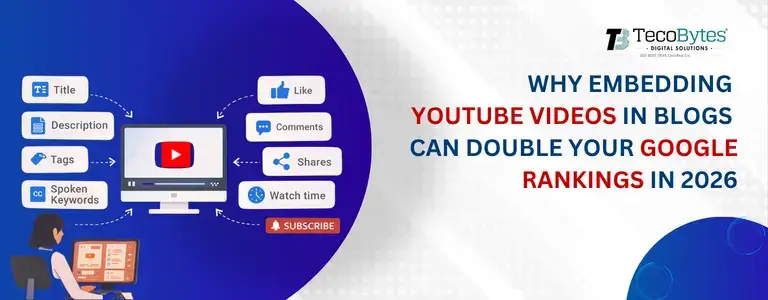
Search Engine Optimization is becoming much more of a fluid system, with businesses aiming to improve on their techniques for increasing rankings and not just on the old approaches such as building lots of links and keyword stuffing. One of the most prominent SEO trends that we will be witnessing in digital marketing in 2026 are Videos in Blogs.
Earlier, blogs relied heavily on text-based optimization, where search engines were able to analyze websites for rankings through keywords, meta descriptions, backlinks and on-page optimizations. All these components are still vital, however search engines now analyze user behavior, multimedia interactions, engagement signals, content depth far more than ever before.
Nowadays people are not just depending on large volumes of plain text. They want tutorials, demos, visual explanations, walkthroughs and an easier, more expedient way to grasp the content. Through this change, businesses are able to gain far more value from embedding videos within blog posts as they provide greater user engagement and search engine visibility compared to simple text articles.
AI-powered search engines are changing the landscape and now analyze websites for usefulness and user engagement, rather than purely for how many keywords they can find. It’s these characteristics that make Videos in Blogs one of the most promising trends in long-term SEO growth in 2026.
Why User Engagement Matters More in 2026
Modern search engines pay close attention to how users interact with webpages after clicking search results.
Earlier, SEO depended heavily on keyword matching and backlinks. Today, user behavior plays a much larger role in determining content quality and search visibility.
Google increasingly evaluates signals such as:
- Time on page
- User interaction
- Scroll behavior
- Engagement duration
- Bounce rates
If visitors leave quickly, search engines may interpret the content as less useful. However, when users spend more time engaging with content, it often creates stronger quality signals.
This is one of the strongest reasons why Videos in Blogs are improving SEO performance for many businesses. Videos naturally increase engagement because users spend additional time consuming visual and audio content alongside written information.
For example, a visitor may spend:
- Four minutes reading an article
- Six more minutes watching an embedded video
This creates significantly stronger engagement compared to text-only pages where users leave immediately after scanning information.
Why Embedding YouTube Videos in Your Blog Posts Can Double Your Google Rankings in 2026
Search engines are becoming much more advanced in understanding content usefulness rather than simply matching keywords. Google increasingly prioritizes webpages that satisfy user intent completely while keeping users engaged for longer periods.
This is one of the biggest reasons why Videos in Blogs are becoming such a powerful SEO strategy in 2026. Embedded YouTube videos improve several important ranking signals simultaneously, including engagement duration, content depth, multimedia relevance, and user experience.
Pages containing relevant videos often keep users engaged longer, reduce bounce behavior, and create richer learning experiences. Search engines increasingly interpret these behavioral signals as indicators of higher-quality content.
Businesses that combine useful written content with educational videos are often achieving stronger rankings compared to websites relying entirely on text-only articles.
Videos also improve accessibility for users who prefer visual learning instead of reading long technical explanations. This creates broader audience engagement and improves overall content usefulness.
As AI-driven search becomes more advanced, multimedia-rich pages may gain even stronger visibility advantages because search engines are increasingly capable of analyzing video transcripts, spoken content, and user interaction patterns.
Videos Improve Content Understanding
Not every user consumes information in the same way. Some users prefer detailed written explanations, while others understand concepts much faster through demonstrations and visual examples.
Videos help businesses serve both audiences more effectively.
For example, a hosting company publishing a VPS setup guide can improve content quality significantly by combining:
- Written instructions
- Screenshots
- Setup walkthroughs
- Video tutorials
This creates a richer learning experience for visitors.
Search engines increasingly reward content that satisfies different user preferences and provides complete topic understanding.

YouTube Strengthens Search Visibility
One reason Videos in Blogs work effectively is the strong integration between Google and YouTube.
YouTube content already plays a major role in Google’s search ecosystem.
Google frequently displays YouTube videos inside:
- Search results
- Featured snippets
- Video carousels
- AI-generated summaries
- Suggested content sections
Embedding YouTube videos inside blog posts strengthens multimedia relevance while improving topical depth.
Businesses using YouTube strategically often gain additional visibility opportunities across both traditional search and AI-powered search systems.
AI Search Is Becoming More Multimedia Focused
AI-powered search systems are evolving rapidly.
Modern search engines now analyze:
- Spoken words in videos
- Video transcripts
- Audio context
- User interaction patterns
- Semantic relationships
This means videos contribute additional contextual information supporting the written article itself.
As conversational AI search continues growing, multimedia-rich pages may achieve stronger visibility advantages.
Businesses using Videos in Blogs are positioning themselves better for future AI-driven search environments where multimedia understanding becomes increasingly important.
Videos Improve Mobile Engagement
Mobile users now dominate internet traffic globally. Modern audiences increasingly prefer visual content because it allows them to consume information more quickly on smaller screens.
Videos improve mobile engagement significantly because users can understand topics faster without reading lengthy technical explanations. Websites optimizing both written and visual experiences often perform better on mobile devices.
This is increasingly important because Google prioritizes mobile-first indexing heavily.
Videos Increase Shareability
Video content often performs better across social media platforms compared to text-only articles.
Users are more likely to share:
- Tutorials
- Product demonstrations
- Educational videos
- Walkthroughs
- Visual explainers
This increased sharing may generate:
- More traffic
- Additional backlinks
- Higher brand visibility
- Better engagement signals
Indirectly, these factors may support stronger SEO growth over time.
Why Text-Only Blogs Are Becoming Less Effective
Many websites still rely heavily on long text-only articles without multimedia support.
However, user expectations have changed dramatically.
Modern users increasingly expect webpages to provide:
- Better usability
- Interactive learning
- Faster understanding
- Multimedia experiences
- Visual explanations
Search engines increasingly reward webpages delivering richer content experiences.
This is why businesses relying only on traditional text-based SEO strategies may struggle against competitors using multimedia more effectively.

How Businesses Should Use Videos in Blogs Properly
Simply adding random videos will not automatically improve rankings.
Businesses should use Videos in Blogs strategically.
Use Relevant Videos
Videos should directly support the topic being discussed.
For example:
- SEO article → SEO tutorial video
- Hosting guide → Server setup walkthrough
- Fitness article → Exercise demonstration
Irrelevant videos weaken content quality and reduce trust.
Place Videos Naturally
Videos should appear exactly where users benefit most from additional explanation.
Avoid placing videos randomly without context.
Optimize Video SEO
Businesses should optimize:
- Video titles
- Descriptions
- Tags
- Captions
- Thumbnails
Proper optimization improves discoverability across both YouTube and Google search.
Maintain High Video Quality
Poor-quality videos may damage trust instead of improving engagement.
Businesses should focus on:
- Clear visuals
- Helpful explanations
- Good audio
- Professional presentation
Videos Strengthen Trust and Authority
Videos often improve credibility because users can visually experience expertise.
Customers tend to trust businesses more when they can:
- Watch demonstrations
- View tutorials
- Hear explanations
- Observe practical examples
This increased trust may improve conversion rates alongside search visibility.
Businesses combining educational content with videos often build stronger authority within their industries over time.
Common Mistakes Businesses Should Avoid
Adding Too Many Videos
Too many videos may overwhelm users and slow webpage performance.
Ignoring Website Speed
Heavy video embeds may negatively affect loading times if not optimized correctly.
Replacing Text Completely
Videos should support written content rather than replace it entirely because search engines still rely heavily on text understanding.
Ignoring Accessibility
Captions and transcripts improve accessibility while helping search engines understand video content more effectively.
The Future of SEO Is Multimedia Driven
Search behavior is becoming increasingly visual, conversational, and AI powered.
The future of SEO will likely involve stronger integration between:
- Written content
- Video content
- Voice search
- AI-generated summaries
- Interactive experiences
Businesses capable of building multimedia-rich content ecosystems may achieve stronger long-term rankings and visibility.
This is why Videos in Blogs are no longer just an engagement tactic. They are becoming a major SEO strategy focused on authority building, user satisfaction, AI visibility, and long-term search growth.
Final Thoughts
The increasing importance of Videos in Blogs reflects the major transformation happening in SEO during 2026. Search engines are no longer evaluating webpages based only on keywords and backlinks. They increasingly prioritize user engagement, multimedia experiences, content usefulness, and overall satisfaction.
Videos help to improve user spending time on page, strengthen content depth, reduce bounce behavior, support mobile engagement and create stronger learning experiences for users. As AI-powered search continues evolving, search engines are becoming far better at understanding multimedia content and behavioral signals beyond traditional keyword optimization.
Businesses combining high-quality written content with useful videos are positioning themselves for stronger rankings, higher authority, and better audience engagement. Websites still relying entirely on text-only strategies may struggle as search competition becomes increasingly focused on user experience and multimedia value.
The future of SEO belongs to businesses capable of creating engaging, informative, and multimedia-rich content ecosystems. Using videos naturally inside blog content is becoming one of the most effective ways to improve Google rankings and long-term digital visibility in 2026 and beyond.